
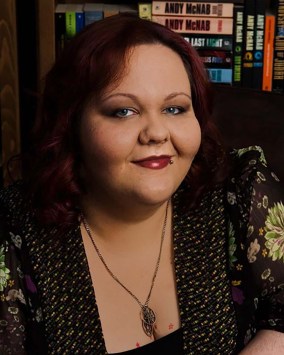
Amanda Geisler has been a dedicated reader since a young age, always searching for new materials to devour. She began writing short stories at the age of 9, musing over the worlds she created before being introduced to the world of novels in her early teen years. Amanda is an enthusiastic reader and writer of young adult urban fantasy and paranormal novels.
 The White Wolf trilogy has been Amanda’s foundation project. Having started the original version when she was 13, The Stray was a work in progress for several years until she finally finished it in 2016.
Besides reading and writing, Amanda lives and works in Brisbane as an early childhood educator while she continues to study towards a Bachelor of Education at university. Amanda uses her spare time to continue with her writing projects and to attend events such as Supanova and Genre Con.
Favourites
Favourite book/s: Rick Riordan – Percy Jackson and the Olympians
Favourite film/s: Harry Potter Series
Favourite television series: Teen Wolf
Favourite colour: Purple
Favourite Sesame Street character: Big Bird
Favourite subject in school: Maths
Favourite special place: My bed
Ideal holiday destination: Europe
Dislikes
Food you can’t stand: Mushrooms
Something you’d never be caught dead wearing: Hot Pink (unless for charity event)
Fears: Claustrophobia, stairs
Least favourite sport: Cricket
Quirky questions
An age you are not: 25
A random hobby you had for like five minutes once: Photography
Best Skittle flavour: Purple/Grape
Writing related
What inspired you to write your current work:
What genres do you read and write: I read and write a lot of urban fantasy and paranormal novels. Sometimes read horror. Rarely romance.
When did you start publishing with Ouroborus: 2016
Current work-in-progress: The Lost
What can readers expect from you in future: My writing career has taken a bit of a hiatus as my university, personal and working personas take more importance. However, I am working on The Lost and will get it out as soon as it’s ready.
Which of your own characters do you relate to most, and which is your favourite to write: I feel I connect and relate to Rya most of all. Probably because I have spent so much time in her head and some of my personality is in her. I am looking forward to writing from Dylan’s point of view as the series progresses. He is a charismatic, sarcastic and cheerful character that I believe will be interesting and fun to write.
What upcoming or recently released Ouroborus book are you most eager to read and why? I am looking forward to reading Blank. I have had it on my shelf for a few months now and I have been waiting for time to read it.
Either or
Hardcover, eBook or paperback? Paperback
Chocolate or chips? Both (depends on mood)
DC or Marvel? Marvel
Blue ink or black? Both (depends on mood and what it is used for)
Indoors or outdoors? Indoors
Spotless work space or is there a desk under all that? Bit of both
Coffee or tea? Neither
You can find out more about Amanda Geisler here and the books can be purchased from the Ouroborus Books online store.
 Ichigo Kurosaki from Bleach – his theme was to protect. He wanted to protect a mountain load of people after his mother died protecting him. It is an important note of him throughout the series, his downfall, however was the ending when his character was literally trashed to the point of no return.
 No wonder it seems to be the most relatable story told in recent western culture. At the very least, it’s one of the most viewed and loved. Somewhere between a little genre film some forty years ago that by all rights should never have gotten off the ground, two trilogy revivals, successful transitions to books and games, a multi-billion-dollar buyout and countless Lego sets, we find, arguably, the largest media thing our world has ever seen.
 Instead we’re better off looking at more qualitative research methods, observation being key among them. Note the consistency of Slave Leias, Darth Vaders and Jedi robes in Comic Con cosplay parades each year, never affected by the rise and fall of other major fandoms. Note the permanence of Star Wars classic lines of dialogue in the western vernacular. Luke, I am your father. Do or do not, there is no try. May the Force be with you. Note the familiarity of young children with characters from films they haven’t yet seen, toting Han Solo lunchboxes and Finn backpacks to school after having absorbed their parents’ and older family’s love for the franchise.
 Possibly the most significant indicator of the cultural impact of Star Wars is its complete lack of visible impact. Like an asteroid so big it flattens an entire landscape, the impact of a media giant isn’t in dents and craters observable to the naked eye. There’s no pocket of nerds whispering about Star Wars behind artfully constructed walls of upside-down textbooks. There are no petitions being pushed around the internet by desperate fans trying to save their fandom from cancellation. And there’s no word for being a Star Wars fan. While Trekkies reading this are already mad with me for referring to Star Wars as the world’s biggest media franchise when theirs obviously started even earlier, the fact remains that their fandom has remained securely in nerd hands throughout the decades. This has its own field of benefits, and I could write an essay about Star Trek possibly being more of a science fiction fandom while Star Wars is definitely a media one, but I have enough essays to write that I’m ignoring in favour of this blog post. Contrary to Trek, George Lucas’s more fantasy-styled sci-fi has, somewhere along the way, transitioned from nerd territory to mainstream. When someone says they’ve never seen *insert science fiction film title here* you usually cut them some slack on the account that not everyone is a genre fan. When that title is Star Wars, you usually assume they’ve been living under a rock. Like, you have to have been actively avoiding it to have missed it for long, right?
 With over 10 years’ experience in the independent publishing field, artist, writer, editor and book designer Sabrina RG Raven has learned to mix her passion for art, design and the written word not only to create her own works of fiction but to help publish other authors.


 It is customary to hold the great authors up as the sources of all wisdom in our craft and we can’t have a conversation about the greats and the wisdom they bestowed on us without bringing up Ernest Hemmingway. So, despite my status as a mere mortal I would like to raise a few objections to some of the facts that we now take for granted because a genius said them.
 This isn’t just about Hemmingway either, it’s about all the greats. A lot of great writers gave a lot of very good advice but not all of it applies to you. People give advice based on what’s worked for them in the past and maybe it helped Hemmingway to believe his first draft was going to be garbage no matter what he did but that doesn’t mean that’ll help you. You can take advice from Stephen King, Shakespeare, Terry Pratchett, all of the above or none of them but the idea of idolising great writers until everything they say is unquestionable gospel is harmful to you as a writer.
 Tell us about yourself: I was diagnosed with Mild Cerebral Palsy when I was a year old and Asperger’s Syndrome when I was twelve. In terms of my writing style I write in the first person. I haven’t had much experience with writing books. Before I published my first book, I actually wrote another book, because I had way too much in my head. And that’s basically how I got into writing. I am such a fantasy nerd, ever since I was little. I also love a few of the old T.V. shows like Bewitched and I Dream of Jeannie. One of my inspirations is Cassandra Clare, she researches every one of her books extremely well and portrays a realness into each of her characters. Inner Reflection is my first ever publication.
 Age I am not? 40.
 Hardcover, ebook or paperback? Hardcover, because there’s hardly any of them in bookstores.
 You can find me on Facebook at
 Children of the Locomotive
  Amity
Amity  Haunted
  Eye of the Storm
 The Lost Heirs
 Ouroborus Book Services